
I spend the day exploring Mammoth Cave National Park outside Bowling Green, Kentucky, visiting the cave and taking advantage of the many miles of hiking trails along the Green River Gorge.

A Warm Spring Kentucky Morning
There’s a slight breeze rustling the oak leaves high above my head as I walk down the wide concrete path towards the entrance to Mammoth Cave. The warmth of the sun permeates the canopy above, the temperature a balmy 75 degrees. I have a ticket for the 10:45 am self-guided historic tour, the only tour at Mammoth Cave National Park currently offered due to COVID-19 restrictions. Our group lines up to enter the cave and a ranger clicks a counter as we pass.
The entrance to the cave is a sinkhole that opened up many thousands of years ago, cutting off a smaller entrance some ¾ of a mile away – that entrance is known as Dixon Cave and is considered independent of the Mammoth Cave system. There is a slight but steady cool breeze drifting up from the cave as I climb down the 70+ steps into the cave’s twilight zone and pass under a small waterfall that trickles 20 feet down to the cave floor before entering the cave through a heavy-duty metal gate.

A Mammoth Cave
The Mammoth Cave system is the most extensive cave system in the world, extending through some 415 miles of discovered underground tunnels formed in the walls of the Green River Gorge. The cave formed in layers of limestone as water from sinkhole plains in the surrounding area formed underground streams and worked its way through the ground to the Green River. As the Green River cut deeper into its gorge, the water sought out more direct ways to the gorge floor, forming wide river tunnels through the limestone as it did. Much of the upper reaches of Mammoth Cave are completely dry and the cave gets increasingly moist as you descend into the depths not covered by the basic self-guided tour.
As I descend down through the Houchins Narrows towards the Rotunda Room, the air gets decidedly cooler and without a jacket, I wrap my arms around myself and think warm thoughts. Mammoth Cave is dimly lit but the lighting brings out the natural color of the cave wall, making for some great photo opportunities.

The Rotunda
Entering the Rotunda is like walking into the grand hall of a mansion but on a scale that dwarfs anything manmade. Some 150 feet below the surface of the earth, the Rotunda is the central feature of the self-guided tours. The Rotunda’s main feature is the saltpeter works used to process nitre for making gunpowder during the War of 1812. At this point, the main path forks and heads left down Broadway for about ¾ of a mile to the Consumption hospital and heads right about ¼ of a mile down Audubon Avenue to exhibits on the history of the cave and its uses for Native Americans in the area.
Audubon Avenue
I go right first, breaking off from much of the group, and head down Audubon Avenue. This fork takes you to a dead end that was once the Echo River’s exit point into the Green River Gorge many thousands of years ago. Without the cave-in that has blocked the opening, this spot would provide spectacular views of the Green River Gorge below. The exhibit on Native Americans is easy to miss as you walk buy. It consists of several round displays placed over the railing and filled with items that have been found in the cave over the years of exploration.
Tuberculosis Huts on Broadway
The longer route from the Rotunda leads through the cave to the site of a consumption hospital, part of a medical experiment in the early 1800s to test the cave environment as a treatment site for tuberculosis. 15 subjects descended into the cave for several months and only left again when the experiment was canceled after 5 of the subjects died. Along the way, you pass the well-preserved pipes that were used to carry nitre to the saltpeter works; the “church” where religious services were held throughout Mammoth Cave’s history; and the Giant’s Coffin formation. The winding path leads to the end of the lit part of the cave and offers you the chance to stare past the eerie tuberculosis huts into the darkness beyond. In the pre-COVID times, Mammoth Cave National Park offered lantern tours of the cave to replicate the cave tours of the 1800s, but at this time, this is the closest you can get to experiencing the cave in its natural, dark state.
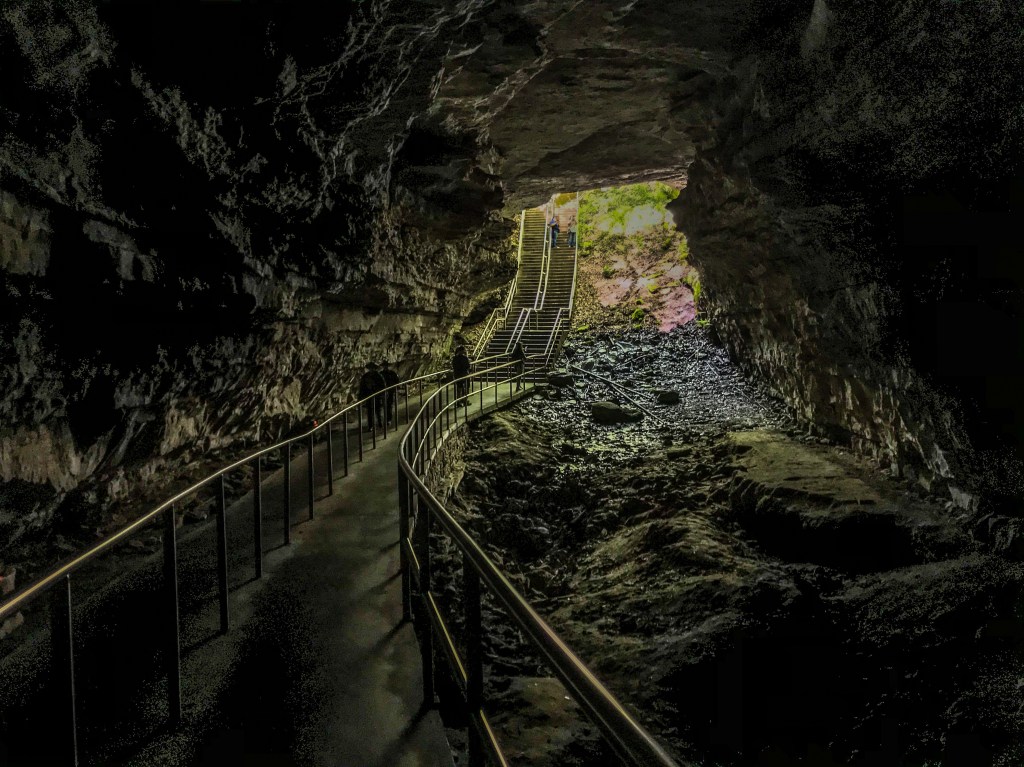
After almost 2.5 hours, it’s time to ascend back to the surface. You are given all the time you’d like to spend in the cave, but most people take 1-3 hours to finish the self-guided tour. As I pass through the metal gates at the entrance, the warm air feels refreshing after so long in the cool environment of the cave. The waterfall trickles away, the same way it has for eons, and I walk back into the sunshine once again.
 Parker Outside